
A Critical Discovery Reveals Hope for Vietnam’s Endangered Primates
Recent field surveys in central Vietnam have confirmed that some of the country’s most threatened primates are still surviving in the wild — and in places where their presence had never before been officially documented.
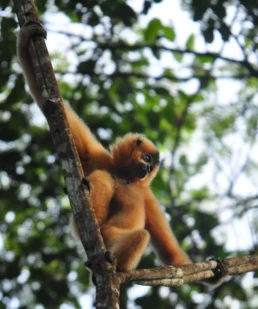
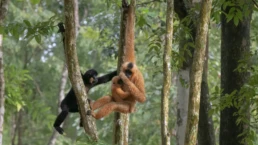
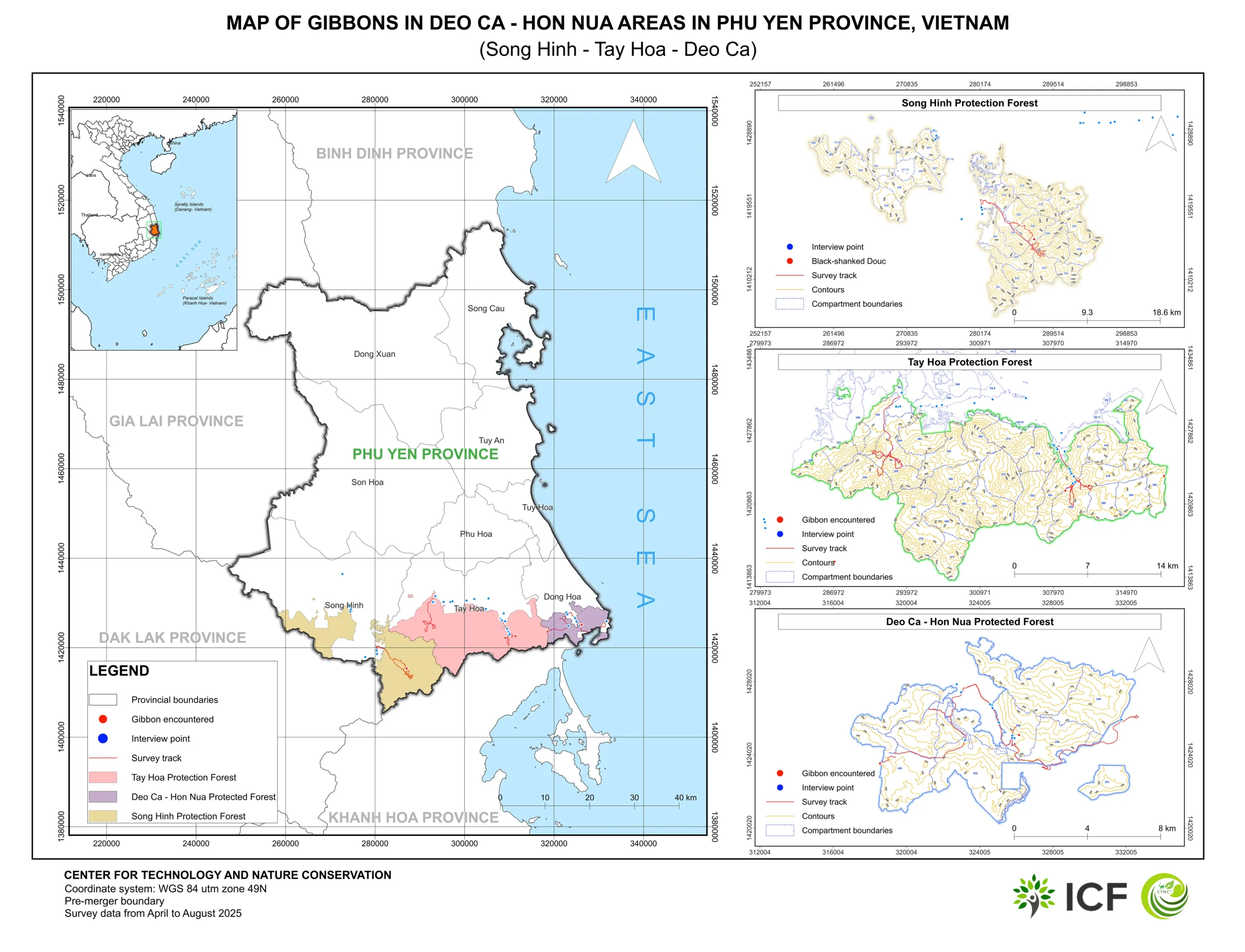
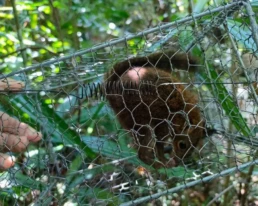
Within the contiguous forest complex of Deo Ca – Tay Hoa – Song Hinh, researchers confirmed six groups of Endangered Red-cheeked gibbons (Nomascus gabriellae), representing at least 15 individuals, and made a first-ever confirmed discovery of a group of Black-shanked douc langurs (Pygathrix nigripes) in Song Hinh Protection Forest. This finding marks the northernmost recorded distribution of the species to date.
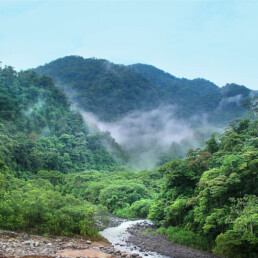
Covering more than 154 kilometers of systematic transect surveys, the study documented primate presence primarily through early-morning vocalizations, along with feeding and resting signs concentrated in streamside and riparian habitats. These forests form a connected landscape of up to 130,000 hectares, recognized as both a Key Biodiversity Area (KBA) and an Alliance for Zero Extinction (AZE) site, underscoring their global ecological importance.
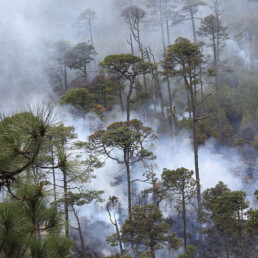
Despite this significance, the region faces persistent threats from hunting, habitat fragmentation, infrastructure development, and enforcement gaps — pressures that make these discoveries both hopeful and urgent.
Local Leadership at the Core: CTNC’s Role on the Ground
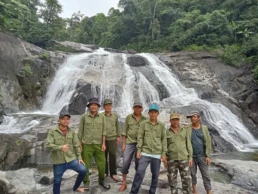
These results are the outcome of a project led by the Center for Technology and Nature Conservation (CTNC), a Vietnam-based grassroots NGO working directly with local authorities and communities to protect the country’s remaining wildlife and habitats.
Through a combination of scientific field surveys, technology-based monitoring, and community engagement, CTNC has demonstrated how locally led conservation can deliver concrete, measurable outcomes in complex and challenging landscapes.
The People Protecting the Forest: Rangers, Data, and Daily Patrols
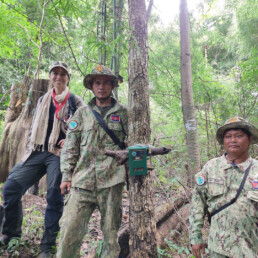
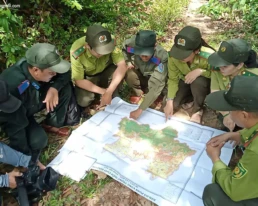
A central pillar of the project focused on improving forest protection by equipping rangers with modern monitoring tools. Between April and August 2025, CTNC conducted three SMART training courses across Deo Ca Special-use Forest, Tay Hoa Protection Forest, and Song Hinh Protection Forest, training a total of 67 forest protection staff.
The Forest Has Neighbors — and They Matter
Recognizing that conservation cannot succeed without public understanding and support, CTNC also invested in outreach and education.

Environmental education programs reached nearly 1,000 students and teachers across three secondary schools, many of whom were unaware that globally threatened primates and turtles lived in the forests surrounding their communities. At the same time, public awareness campaigns using commune loudspeaker systems reached over 10,000 local residents, delivering repeated messages on wildlife protection laws, ecological importance, and legal consequences of illegal hunting and trade.
For the first time, patrol data were systematically recorded with GPS tracks, time stamps, and standardized threat reporting — allowing forest managers to identify enforcement hotspots and respond more effectively.
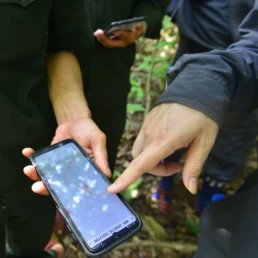
This effort moved quickly from training to real-world implementation. Following the handover of SMART-enabled mobile devices, patrol teams in Tay Hoa alone conducted:
21
patrols
46
patrol days
305.59
km covered
570
patrol hours logged
Why Local, Comprehensive Conservation Matters
Protecting Vietnam’s endangered primates is still possible — but only if these efforts are sustained and scaled. Support locally led conservation initiatives that combine science, enforcement, and community engagement to safeguard critical habitats before they are lost.
The achievements of this project — from species discoveries to improved enforcement and community engagement — were only possible because the work was led by people who understand the landscape, the species, the threats, and the social realities on the ground.
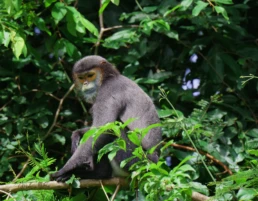
Photo by Tang A Pau
Effective conservation is not a single action or tool. It requires local expertise, scientific rigor, enforcement capacity, and community involvement, working together as a cohesive strategy. CTNC’s work in Phu Yen demonstrates what is possible when conservation is approached comprehensively and led by the right people in the field.

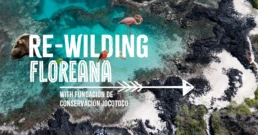
Rewilding the Galapagos: Bringing Back Lost Species
Rewilding the Galapagos: Jocotoco Is Bringing Back Lost Species
Galapagos. Close your eyes for just a moment. What images does the name conjure in your mind? Primordial forces: volcanoes, evolution. Bizarre creatures, blue waters teeming with life. Nature—untamed, isolated, and unspoiled by humans.
For millions of years, this is how the islands looked. Just as volcanic activity continuously shaped them, life on the islands took its own course, and evolution created a completely unique ecosystem, as it often does on remote islands. This remained the case for millennia until the first humans set foot on the islands in the 16th century. Sporadic visits by pirates and whalers were enough to take a terrible toll on the ecosystem. As with most islands, the Galapagos suffer from invasive predators introduced both deliberately (goats and other domesticated animals) and unintentionally (rats and mice). These invasives have decimated local populations of birds and other wildlife. Hunting by whalers and pirates over the centuries disrupted the ecosystem’s balance and wiped out many endemic species.
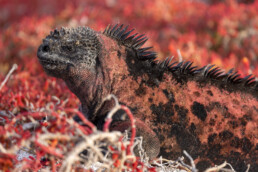
Pink Land Iguana, Marlon del Águila
Today, our partner Jocotoco has an ambitious plan to restore the beauty and diversity of the Galapagos Islands for future generations, harnessing the ecological superpowers of a tortoise species once thought extinct. The rewilding of the Galapagos island of Floreana, will make it the largest tropical island ever to be rewilded!
First Step: Removing Invasive Species
The first step was removing invasive predators from the island, which was accomplished toward the end of last year. This was no easy task. Eradicating invasive species like rats, mice, and feral cats on a 173 km² island is a monumental challenge, but it was successfully completed thanks to the tireless efforts of Jocotoco, the Galapagos National Park, and many local and international partners.
“Invasive species are destroying our island. They devour crops and are pushing our seabird populations to the brink of extinction. We catch less fish every year. By removing invasive species, we have the opportunity to restore both the land and the sea and provide more ecotourism opportunities for the first time on an inhabited island in the archipelago. Our livelihoods, our health, and the next generation’s future depend on it.” —Max Freire, Floreana Island native and fisherman
“Every action has a reaction, and it has been well-established that removing invasive species from islands paves the way for ecosystem recovery.” —Chad Hanson, Deputy Vice President of Conservation at Island Conservation (source)
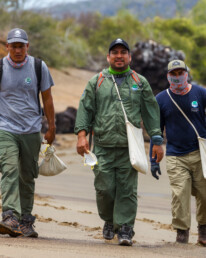
Park rangers working on manual bait dispersion during the invasive species eradication phase. – Photo by Joshua Vela
Next Step: Reintroducing Lost Species
“Rewilding is a key concept in this endeavor, as it involves returning these species to their natural environment—a crucial step toward revitalizing a healthy and balanced ecosystem.” – Jocotoco website
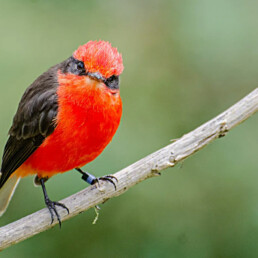
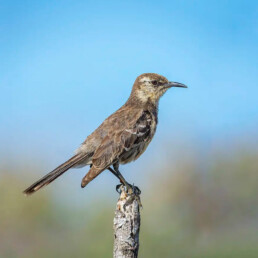
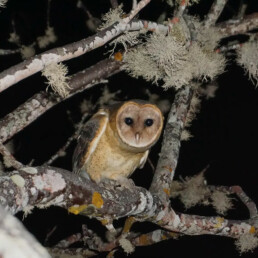
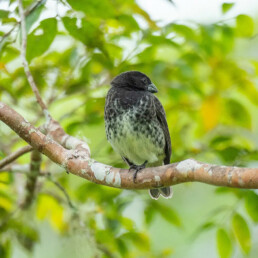
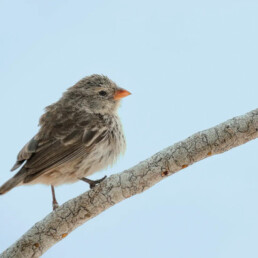
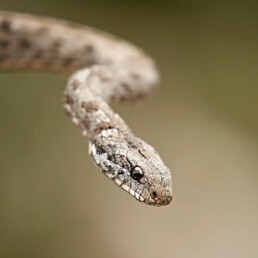
With the invaders gone after 150 years, it’s time for the most exciting part of the rewilding process: bringing back the lost species! Our partners at Jocotoco aim to reintroduce 12 of the 13 locally extinct species to their natural habitat, including the Floreana Giant Tortoise, Floreana Mockingbird, Little Vermilion Flycatcher, Galapagos Rail, Lava Gull, Galapagos Hawk, Vegetarian Finch, Gray Warbler Finch, Sharp-beaked Ground Finch, Large Ground Finch, Barn Owl, and the Floreana Racer Snake.
Earlier this year, more than 500 Darwin’s Finches were released on Floreana Island. The birds are successfully returning to their natural territories! Though small, their presence has a large impact: they pollinate, disperse seeds, and control insect populations.
“We’ve planned this moment for so many years; it’s surreal to experience it. The release of these finches marks a monumental moment for the future of Floreana.” – Paula Castaño, from Island Conservation (source)
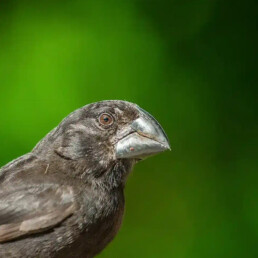
Large Ground Finch by Jocotoco
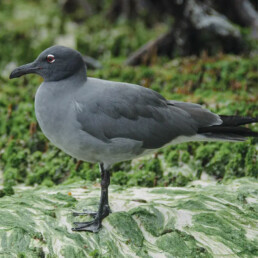
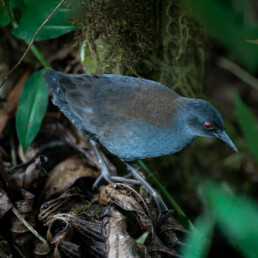
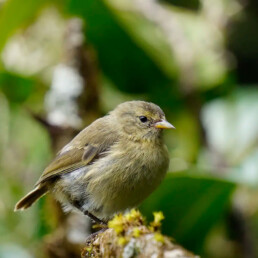
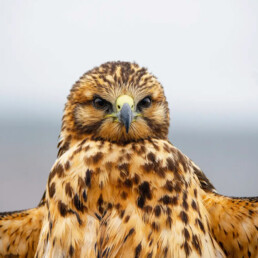
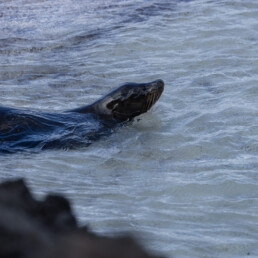
The Ecological Engineers Are Returning
The Floreana Tortoise went extinct over 150 years ago, likely during the 1840s or 1850s. By the time Charles Darwin famously visited the Galápagos Islands in 1835, decades of overharvesting had already brought the population to the brink of extinction. Darwin noted that only about 20 years’ worth of harvestable tortoises remained. The species finally disappeared around 1850.
Fortunately, in 2012, several hybrids between the extinct Floreana Tortoise and Chelonoidis becki, another subspecies, were discovered near Wolf Volcano on Isabela Island. These were likely descendants of Floreana tortoises transported there in the early 19th century. In 2017, a breeding program was launched to revive the Floreana subspecies. By 2023, the program had successfully produced around 400 offspring, offering a unique opportunity to repopulate Floreana Island with tortoises that closely resemble the genetic makeup of the original Floreana Giant Tortoise.
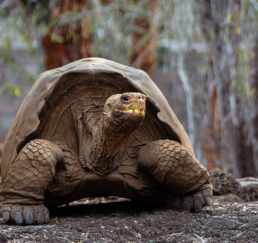
Photo by Diego Bermeo, DPNG
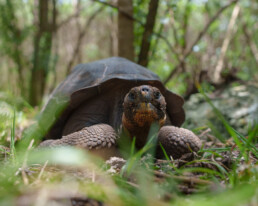
Galápagos Tortoise, Josgua Vela
The return of the tortoise to Floreana will be more than a symbolic victory. The tortoise will serve as an environmental engineer, transforming the island to benefit other endangered species. Not only do they disperse seeds and move soil, but they also “terraform” the habitat by consuming large amounts of lower vegetation, opening up the understory for foraging by species like the endangered Floreana Mockingbird and Little Vermillion Flycatcher. Jocotoco’s work in the Galapagos represents a unique conservation opportunity with lasting consequences for Floreana and the preservation of Earth’s biological treasures.
“This restoration project yet again demonstrates the importance of coordinated efforts between institutions and organizations dedicated to conserving the Galapagos Islands. Large-scale projects like this can only achieve positive results when all conservation stakeholders pool their knowledge, efforts, and collective experience.” —Rakan Zahawi, Executive Director of the Charles Darwin Foundation (source)
Time to make a real impact
This work might be expensive and challenging, but it’s worthwhile! The 160 people who live on Floreana have already seen their crop yields increase dramatically with no rats or mice around. The return of tortoises and birds will bring increased tourism revenue, a win-win for both people and wildlife.
At ICF, we’re thrilled to support Jocotoco’s work in Floreana, and we’re eager to invite you to join us. Support Jocotoco’s work in Floreana through ICF, and let us know if you’re interested in joining an ICF trip to the Galapagos in 2025! Jocotoco’s tour company, Jocotours, offers a unique opportunity to see this incredible work firsthand.
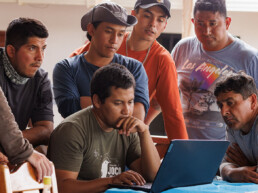
Juan Pablo Mayorga (Jocotoco Foundation), coordinating work with Biosecurity Agents (ABG) Photo by Joshua Vela
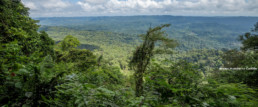
Celebrating Earth Day from Ecuador! | April, 2024
Dear friends,
For Earth Day we highlight the work of the Jocotoco Foundation based in Ecuador.
Ecuador is a mega-diverse country with the highest biodiversity per area of any country. Many species in Ecuador are found only in very small areas (endemics). Tiny Ecuador is home to 16% of the world’s bird and 10% of the world’s amphibian species. Ecuador was the first country to give nature constitutional rights and it has protected close to 20% of its land and sea territory. In spite of these successes, the threats remain. For example, over 95% of forest has been lost in the lowlands of western Ecuador.
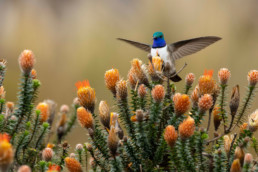
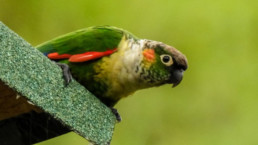
The population of many parrots is limited by the availability of nest cavities because so many trees have been cut down. A nest box program provides homes to these birds like this rare White-breasted Parakeet until the forest can regrow. Photo: Byron Puglia.
Jocotoco was established in 1998 to protect the many endangered and endemic species which are still not protected by Ecuador’s relatively extensive system of protected areas. In 25 years, Jocotoco has established 18 conservation reserves totalling over 40,000 ha.
The foundation’s first reserve was established to protect the Jocotoco Antpitta is south-eastern Ecuador – then a new species to science. The foundation flourished and initially focused on protecting endangered birds like the El Oro Parakeet, Ecuadorian Tapaculo, Pale-headed Brush Finch, Great Green Macaw, Black-breasted Puffleg and Andean Condors.
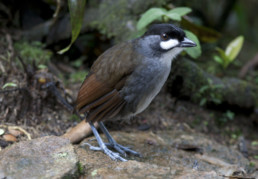
The Jocotoco Antpitta was discovered in 1998 in southern Ecuador. The population is thought to be around 500. Photo: Doug Wechsler
Jocotoco now protects over 10% of all the world’s bird species in just 0.00003% of the world’s land area.
Jocotoco quickly recognized that to protect endangered birds, they had to protect the habitats and ecosystems in which they lived. This meant working with many stakeholders, communities, and governments in order to protect larger areas. The results have been astonishing, showing how resilient nature can be if given a chance! In all its reserves, Jocotoco has seen a marked increase in rare species, especially in areas reforested to reconnect remaining old growth forest patches.
“I have watched and supported Jocotoco since they first were formed. It is inspiring to see how much land and critical habitat has been conserved in just 25 years and how well this has been supported by the communities and governments in Ecuador. Seeing these natural ecosystems recover so quickly with protection is a very hopeful message for Earth Day!”
Jerry Bertrand, Founding Board Member ICF
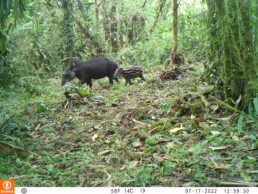
With habitat protection on conservation reserves, large mammals like these Mountain Tapirs have returned and are increasingly common. Photo: Jocotoco
Protecting the Lowland Chocó
ICF and its staff have been supporting Jocotoco’s major initiative to protect the Chocó Forest Ecosystem since 2016. With less than 2% of the original forest remaining in this species and endemic rich area, the situation is still critical. To date over 15,000 ha has been protected by Jocotoco and its partners and a connection has been established between Jocotoco’s reserve and Cotocachi-Cayapas, one of Ecuador’s largest national parks. While much more work remains to be done, the establishment of these protected areas is ensuring the long-term survival of healthy populations of Jaguars, Harpy Eagles, and Peccaries. The removal of hunting pressure has seen the return of shy species like the Great Curassow, and recently a Giant Anteater.
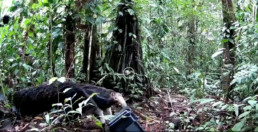
Click to view this video of a Giant Anteater at Jocotoco’s Canandé Reserve: one of the first records of this species west of the Andes in a very long time.
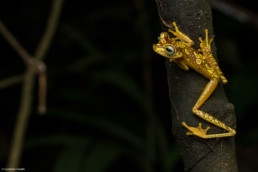
Photo: Humberto Castillo
Canandé Reserve becomes Ecuador’s Newest National Park
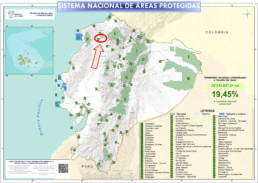
In November 2023, the Government of Ecuador included 2900 ha (about 25%) of Jocotoco’s Canande Reserve into the National Park System. The advantage is that this provides legal protection from all extractive uses – particularly mining. Jocotoco is working with the government and community groups to include the remaining areas. You can see Canande as Ecuador’s newest national park — # 78 on the attached map. This brings Ecuador’s National Park System coverage to almost 20% of the country.
Science Innovation in the Chocó
Effective conservation depends on having the best knowledge available. When Jocotoco started to work in the Chocó in 2000, almost nothing was known about the area and how complex it was. It was a very difficult region of the world to reach and get access to.
After much preliminary work, a coalition of German, Ecuadorian and other international researchers established a research program to explore and understand the Chocó. This led to the formation of the REASSEMBLY project led by Nico Blüthgen and Martin Schaefer – funded by the German Science Foundation.
In short, this is targeted research to understand how complex tropical forest ecosystems work and how ecosystems reassemble themselves after disturbance from forestry or agriculture. The GOOD NEWS is that almost everything can return within a human generation – nature is resilient if given a chance!
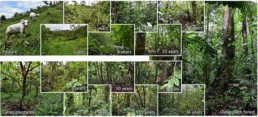
This photo montage shows some of the ecological conditions and age categories of forest being studied by researchers. Photo: REASSEMBLY.
Join us at Chautauqua!
Effective conservation depends on having the best knowledge available. When Jocotoco started to work in the Chocó in 2000, almost nothing was known about the area and how complex it was. It was a very difficult region of the world to reach and get access to.
After much preliminary work, a coalition of German, Ecuadorian and other international researchers established a research program to explore and understand the Chocó. This led to the formation of the REASSEMBLY project led by Nico Blüthgen and Martin Schaefer – funded by the German Science Foundation.
Join us at Chautauqua!
Thanks from all of us and happy spring!
David, Molly, Scott, Jerry, Meade, Wayne and Doug
ICF has a new website and fresh look for Spring! | Newsletter April 2024
At the International Conservation Fund we are also busily refreshing our look and our approach with the launch of a new website. We continue to fund important conservation work for our Canadian partner, but we are branching out to directly fund conservation projects as well. We at ICF, have organized our approach around four overarching themes: Saving Shorebirds; Working with Indigenous Peoples; Protecting Species, and Landscape-level Connectivity, emphasizing climate resiliency and mitigation and migratory corridors. Also new, we feature the work of our in-country field partners to emphasize their success as leaders in their regions who plan and implement community-led, long lasting conservation initiatives.
Take a tour and let us know what you think!
As always, your support makes this important mission possible. Spring is a nice time of year to pitch-in as we start a new year with new partners, and a renewed sense of hope!
Thanks from all of us and happy spring!
David, Molly, Scott, Jerry, Meade, Wayne and Doug